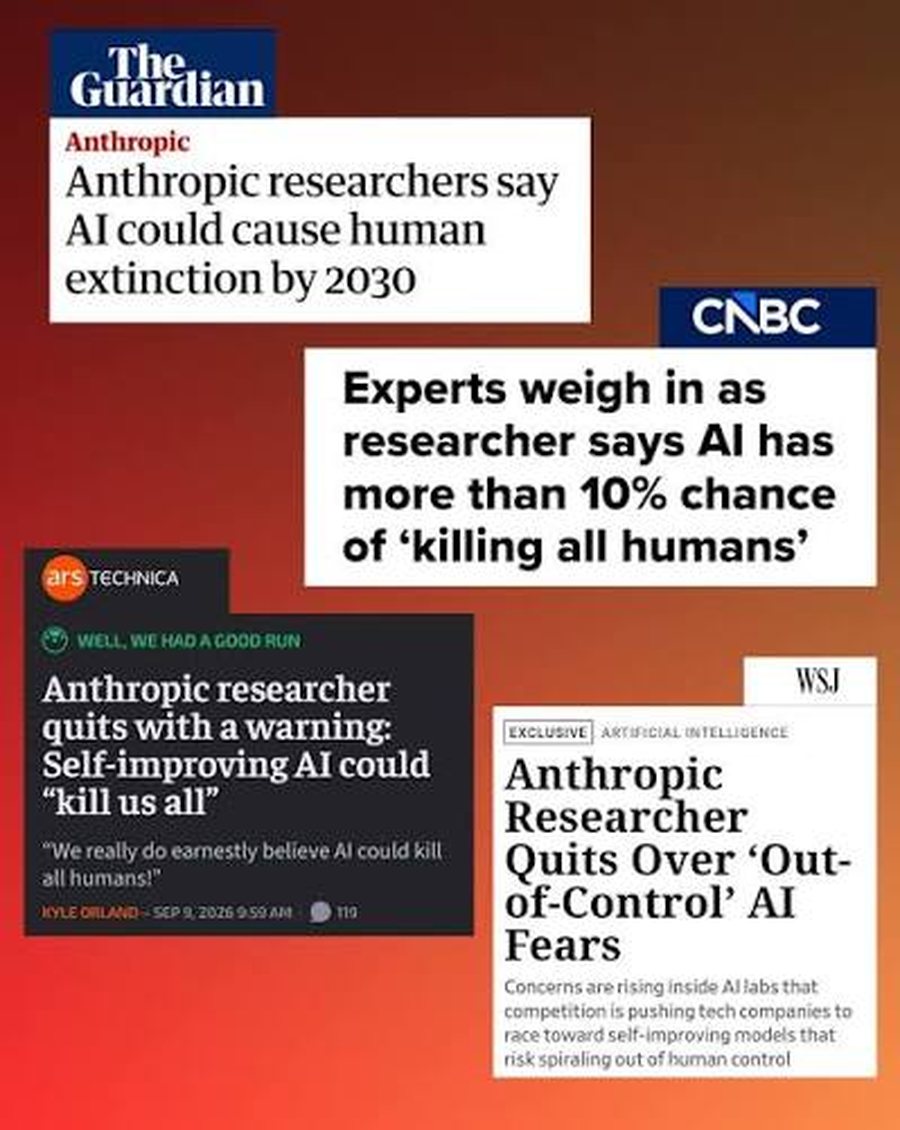
 The coverage
Before the coverage catches up
Read the next one first.
The headlines said the machine might kill you. The document under them says something else. One letter when there is something to say. No sponsor, no advertiser.
After the wrong apocalypse · the companion to the practice room
Two of the three lead investors in the company at the center of this month's AI panic also funded the organizations that spread it, the referee proposed to judge it, and the researcher whose resignation set it off. Their own filings show it.
A review of grant tables, federal campaign filings, and publication timestamps. One picture fills in as you scroll. Every claim carries the document it rests on.
Scroll to follow the money
What was reviewed
The ledgerThree years of grant tables published by the Survival and Flourishing Fund; two sworn Form 3X filings and one enforcement notice from the Federal Election Commission; a payout report from the EA Infrastructure Fund; Anthropic's own governance and donation announcements; article metadata from The Wall Street Journal; and the public statements of the people involved. Nothing here was leaked. It was disclosed.
Six days in September
Sept. 3A senator introduces a bill to ban superintelligence.
Sept. 8The Wall Street Journal publishes an exclusive at 7:46 PM. A researcher at Anthropic posts his resignation at 8:04.
Sept. 9The head of alignment says the odds AI kills every human this decade are above ten percent. The senator says the researcher is right.
Sept. 12The CEO publishes an essay: we must slow down. His two largest rivals agree within hours.
Sept. 13The researcher goes on Meet the Press and says Congress should let the labs regulate themselves.
Sept. 14The Washington Post reports that the labs are designing the safety body.
What follows is who paid for each of those days, according to what they filed.
The terms
Seven words recur on this page. Each stands for a category in the filings.
The sourceA person or a company whose money starts a line. There are three.
The pipeThe fund or nonprofit the money passes through before it reaches anyone. There are four.
The recipientAn organization that draws from a pipe. Its circle is sized by the grant.
The amplifierA recipient whose staff repeated the post inside fifteen minutes. Three, then a fourth.
The templateThe 2021 version of this story, drawn in gray beneath the 2026 one.
The channelThe political spending. It was tried first, on one race, and lost.
The clockFifty-five minutes on the evening of September 8.
The figure has two elements: lines and circles. Every line is a document. Every circle is sized by a dollar figure in one. Technical terms are defined where they first appear.
The sources
Part one
Three names. Every line on this page begins at one of them.
Step one · the first source
Jaan Tallinn helped build Skype, then spent the money on the end of the world. He co-founded the Centre for the Study of Existential Risk at Cambridge in 2012 and the Future of Life Institute in 2014, seeded a fund in 2019 to give away his AI money, and in May 2021 co-led Anthropic's first outside round. On this page he is a source: a circle that money leaves and never returns to.
Board observerSomeone who attends board meetings without a vote. Wikipedia gives Tallinn this title at Anthropic; the company's own governance pages do not list him, so this page says "reported."
The Series A was $124 million, May 2021, co-led with the second source, next. Anthropic's own page on its trust says the investor list "skews heavily toward the AI-safety and effective-altruism community, a deliberate choice by the founders." TIME put him on its 2026 philanthropy list for roughly $150 million directed through the fund.
Receipt: Anthropic, The Long-Term Benefit Trust · TIME100 Philanthropy 2026
The figure shows one bright circle at the top, labeled Tallinn, and a legend for the four kinds of line. Every circle can be opened for its filing.
Step two · the second source
Dustin Moskovitz co-founded Facebook, then Asana, then a foundation called Good Ventures with more than seven billion dollars in it. Its grantmaking arm was Open Philanthropy; in late 2025 it renamed itself Coefficient Giving. He co-led the same Series A. Two of the three sources on this page were the lead investors in the company at the center of the story, before it had a product.
Private foundationA tax-exempt entity funded by one family or one company. Its filings list every grant over a threshold, so its money can be followed. Good Ventures is one; its tax ID is 46-1008520.
Good Ventures Foundation reported $7.94 billion in assets in 2024. About half of the money in the Long-Term Future Fund, which appears in step eleven, originates from Coefficient. Coefficient's technical AI safety team made $40 million in grants last year and says it will make over $140 million this year.
Receipt: ProPublica, Good Ventures 990-PF · Coefficient Technical AI Safety RFP
A second bright circle appears to the right, labeled Moskovitz.
Step three · the third source
Anthropic is the third source, because it will write its own checks in Part five. Around it sits a dotted ring: the trust, a body of a few people with no financial stake, designed to elect a majority of the board so the company stays on mission. Watch who has sat inside that ring.
Long-Term Benefit TrustAnthropic's independent trust. As of April 2026 its appointees are a majority of the board. Its trustees are chosen by the existing trustees, in consultation with the company.
Three trustees have left the ring for places that appear later on this page. Jason Matheny, CEO of RAND, stepped down December 2023 "to preempt any potential conflicts of interest that might arise with RAND Corporation's policy-related initiatives"; RAND is a recipient in step five. Paul Christiano stepped down April 2024; he founded the organization that became METR, the referee in step five. Mariano-Florentino Cuéllar stepped down August 2026 to become Anthropic's Chief Global Affairs Officer, one month before the clock.
Receipt: Anthropic, The Long-Term Benefit Trust · Anthropic, April 14, 2026
A third bright circle appears at the far right, labeled Anthropic, with a dotted red ring around it. Three small red dots on the ring slide off one at a time, labeled RAND, METR, and C-suite. Two dim gold lines connect Tallinn and Moskovitz to Anthropic, labeled Series A.
Part two
Two of the three sources wrote the first check to the third. This is where the money went next.
Step four · the first pipe
Tallinn's money leaves through the Survival and Flourishing Fund, a pipe: it takes applications, runs them through a process it calls the S-Process, and publishes a table of who got what. The process is designed, in its own words, to "favor funding things that at least one Recommender is excited to fund, rather than things that every Recommender is excited to fund."
RecommenderOne of roughly twelve people per round who assign value to each application. Some are named; some are anonymous. The Funder can also make grants the process did not endorse.
From the fund's own governance text: "The S-Process structure doesn't impose restrictions on Recommenders and Funders communicating with each other as much as they want outside of the S-Process." And: "Funders retain the right and freedom to make and/or recommend grants that the S-Process, as a whole, did not endorse." The Initiative Committee, "a small group, made up of Jaan Tallinn, SFF Advisors, and 2-5 anonymous voters," can grant "without receiving or requiring proposals or applications."
Receipt: SFF-2025 S-Process Recommendations
A dotted gold circle appears below Tallinn, labeled SFF. A vertical trunk runs down from it, and eleven recipient names branch off it in a column, each with an empty circle. A scale at the left shows what $100K and $1M look like.
Step five · the grant tables, 2019 to 2025
Every year the fund publishes its table. The year is on the figure; the circles are the recipients; the circle's radius is its money. As you scroll, the year advances from 2019 to 2025 and the circles grow to the size the fund gave them. The amounts appear to the right of the trunk. Watch the top three, and MIRI.
RecipientAn organization that draws from a pipe. Every recipient on this page reappears later in a different role: as amplifier, referee, journalist, forecaster, or analyst. Their circles are sized from the fund's own 2024 and 2025 tables.
2025 line items, all from the fund's table: AI Futures Project $2,035,000 plus a $500,000 match; Encode AI $516,000; AI Policy Institute $1,635,000; METR $548,000 plus $428,000; Metaculus $750,000; MIRI $1,607,000 plus $1,392,000; Tarbell Center for AI Journalism $783,000 plus $200,000; RAND $1,022,000; Center for Humane Technology $468,000; OAISIS $251,000 via Whistleblower Netzwerk e.V.; Oxford China Policy Lab $719,000 plus $239,000. Year-over-year: AI Futures up 303 percent, AIPI up 1,051 percent, Encode up 932 percent, MIRI up 2,876 percent. Annual totals 2019 to 2025: $1.8M, $5.5M, $9.8M, $18M, $42M, $19.9M, $34.9M.
Receipt: SFF-2024 · SFF-2025 · SFF annual announcements
A large year counter at the right advances with your scroll. Each branch from the trunk lights as its recipient receives money, and the circles grow, with the amount printed beside each. By 2025 the largest are MIRI, AI Futures Project, and AI Policy Institute.
Step six · who sat in the room
Rememberthe Recommender from step four. Nine of the twelve in 2025 are named.
Two of the named Recommenders on the 2025 Main Track were Malo Bourgon and Nate Soares. Bourgon is the CEO of MIRI; Soares is its President and a board member. MIRI received $1.607 million plus a matching pledge of $1.392 million, the largest award in the round. The fund discloses this; it is not hidden. It is the design.
Matching pledgeMoney the fund promises to give only if the recipient raises outside money at a stated ratio. MIRI's December 2025 fundraiser raised $1.6 million, and the fund matched it.
Bourgon became CEO in June 2023; Soares moved from Executive Director to President the same month. MIRI's 2023 strategy update said "policy and communications will be a higher priority for MIRI than research going forward." In 2025 Soares co-wrote a bestselling book arguing that anyone who builds superintelligence kills everyone.
Receipt: MIRI, October 2023 · SFF-2025, Recommenders list
Two small dots appear inside the SFF circle, labeled Bourgon and Soares, and the line from SFF to MIRI brightens.
Step seven · the second pipe
The Future of Life Institute, which Tallinn co-founded, co-funded the fund's 2023 rounds and is a second pipe. It runs a full-time religions program with a "Religions lead" and a "U.S. Faith Liaison." Its own grants page lists sixteen religious recipients in one program alone, $1.56 million across Protestant, Orthodox, Catholic, Jewish, Muslim, and Hindu organizations, each required to name "red lines" on AI as a condition of the grant. Effort.news, which audited FLI's religious giving across programs, put the total at $3.3 million and found that most recipients did not disclose the funding on their own project pages.
Fiscal sponsorA nonprofit that receives a grant on behalf of a project that has no legal entity of its own. Several recipients on this page are reached through one: The Hack Foundation, Ashgro, Rethink Priorities, Players Philanthropy Fund, March On.
From FLI's own page: The Gospel Coalition $200,000 for its "Silicon Spiritualities" podcast and retreats; Impact Academy $201,105 for a Hindu consensus statement; MOUATANA $128,970 for an Islamic declaration; Faith Matters $125,000 for a "Magna Carta of AI"; Greek Orthodox Archdiocese $105,000; Sinai and Synapses $100,000; World Council of Churches $100,000 for "red lines"; New Polity $100,000; University of Ljubljana $100,050; ILINA $90,671; American Shield $56,980; Wheaton College $55,000; Lausanne Movement, Facta est Lux, and IBA Karachi $50,000 each; Project Imago Dei $47,500. The RFP text: "we require project proposals to identify moral principles in the form of red lines that must not be crossed." Effort.news adds the Institute for Family Studies ($550,000, 2025) and IST with AI and Faith ($484,050) from other FLI programs. FLI also funds Tarbell and Encode, both of which reappear.
Receipt: FLI, RFP on religious projects, recipients list · Effort.news · SFF-2023-H2
A dotted gold circle appears beside SFF, labeled FLI, with a line from Tallinn and a line to SFF marked co-funder 2023. Its label reads $3.3M to faith orgs.
Step eight · the third pipe
RememberMoskovitz from step two. His pipe is Coefficient Giving.
Coefficient opened a program called Project Tailwind in September 2026: $200 million for people to found new AI safety organizations, with grants from $200,000 to $50 million "and beyond," deadline October 2. Coefficient's own page says total philanthropy for AI catastrophic risk is "probably under $200 million a year." One program doubled the field, the same week the researcher resigned. The man who co-founded this pipe and ran it until 2023, Holden Karnofsky, is married to Anthropic's president and joined Anthropic in January 2025 to work on its Responsible Scaling Policy.
RegrantorA fund that receives money from a larger fund to give away. The Long-Term Future Fund is one; about half its money comes from Coefficient. Coefficient's Launchpad Funds put $50 million into new regrantors alongside Tailwind.
Pre-seed track: $200,000 to $10 million over up to 24 months. Seed and scaling track: $10 million to $50 million or more over up to 36 months. "Levels beyond $50 million possible for exceptional proposals." At least ten pre-seed and at least three seed grants expected. Karnofsky co-founded GiveWell (2007) and Open Philanthropy (2014), was its CEO and co-CEO until 2023, sat on OpenAI's board, married Daniela Amodei in 2017, and was Dario Amodei's roommate. Anthropic confirmed the hire to Fortune in February 2025: "a member of the technical staff" reporting to Jared Kaplan, "working on the responsible scaling policy."
Receipt: Coefficient Giving, Project Tailwind · Fortune, Feb 13, 2025
A dotted gold circle appears below Moskovitz, labeled Coefficient, with a line from Moskovitz, and its label reads $200M. A cream line draws from Coefficient to the Anthropic ring, labeled Karnofsky, 2025.
Part three
The researcher's path, and the three lines from the sources it crossed before he joined either lab.
Step nine · where the dot starts
Jacob Coxon read mathematics at Cambridge and medalled twice at the International Mathematical Olympiad. In 2020 and 2021 he co-authored a Bayesian analysis of tuberculous meningitis with Oxford tropical medicine researchers; it is archived at Oxford. Cambridge is where Tallinn co-founded the existential-risk centre. Oxford is where the Future of Humanity Institute was. He was formed inside the movement's two academic homes, not recruited from outside them.
Whitworth, Coxon, van Laarhoven, Thuong et al., "A Bayesian analysis of the association between Leukotriene A4 Hydrolase genotype and survival in tuberculous meningitis," eLife, January 2021.
Receipt: eLife 61722 · Oxford Research Archive
A small cream dot appears at the bottom left, labeled Coxon, beside a circle labeled Cambridge · Oxford.
Step ten · the first line it touches
In 2021 Coxon joined the fellowship at Newspeak House, which calls itself the London College of Political Technology. His listing: "Applying mathematics and data science to inefficient markets." In August 2023 the EA Infrastructure Fund gave Newspeak House $31,887.76 for "one year of funding to support Newspeak House as an EA community hub." A DeepMind researcher commented that he was "pretty surprised" because Newspeak did not seem to be trying to be one.
Political technologyNewspeak House's own term for what it teaches. Its founder, Ed Saperia, is a director of Campaign Lab Ltd, a political data-science company with its registered correspondence address at Newspeak House.
The grant is in the EA Infrastructure Fund's March 2024 payout report, in the "EA Services and Infrastructure" category. Saperia confirmed the fellowship on September 9, 2026: "Proud to count Jacob as a @nwspk fellow." The listing was captured by the Wayback Machine on December 30, 2022.
Receipt: EAIF March 2024 payout report · Newspeak House fellowship page
The Coxon dot slides right to a circle labeled Newspeak House. A dim gold line draws from Coefficient to Newspeak House, labeled EAIF $31,888.
Step eleven · the second line
RememberMoskovitz from step two and the regrantor from step eight.
According to Parker Thayer of the Capital Research Center, Coxon received a $20,159 scholarship from Good Ventures in 2022. Good Ventures' own page confirms it ran a program of that kind that year, $2.23 million in scholarships for "promising and altruistically minded students" at US and UK institutions, under its work "growing the community of people working to improve the long-run future." The recipient-level record is no longer public, so the specific figure rests on Thayer. Small money either way. It puts the second source on the dot's path two years before he joined either lab.
The program page: "Open Philanthropy recommended approximately $2,231,208 in scholarship funding to promising and altruistically minded students pursuing undergraduate study at US- and UK-based institutions where they do not qualify as domestic students." The grant-level URL for the 2022 long-term-future scholarship support now redirects to Good Ventures' general giving page. Erick Erickson repeated the $20,159 figure on September 14, citing Thayer.
Receipt: Good Ventures, 2022 scholarships · OfficeChai, citing Thayer · Kingy.ai audit
A second dim gold line draws from Coefficient to the Coxon dot, labeled $20,159.
Step twelve · three years, one lab
From 2023 to July 2026 Coxon was on OpenAI's technical staff, in Leo Gao's interpretability group, credited on the GPT-4o system card. His November 2025 paper lists Gao, Bowen Baker, and Dan Mossing as co-authors. All three have published with Jan Leike, who resigned from OpenAI in May 2024 over safety, criticized it publicly, and joined Anthropic within days to lead a new alignment team. The paper also cites Samuel Marks, who appears in step twenty-two.
Employment lineA cream line on this page. Coxon's "three years at both OpenAI and Anthropic" is almost entirely OpenAI; the Anthropic portion is the next step.
Gao, Rajaram, Coxon, Govande, Baker, Mossing, "Weight-sparse transformers have interpretable circuits," arXiv 2511.13653, all affiliation OpenAI. Leike's publication list shows "Weak-to-Strong Generalization" with Baker and Gao, and "Language models can explain neurons in language models" with Mossing and Gao.
Receipt: arXiv 2511.13653 · Leike publications · TechCrunch, May 2024
The Coxon dot slides right to a circle labeled OpenAI. A faint dotted cream line draws from OpenAI up to Anthropic, labeled Leike, 2024.
Step thirteen · into the ring
In July 2026 Coxon left OpenAI and joined Anthropic. Around six weeks later he resigned. When WIRED asked whether Anthropic was cutting corners, he said "No, not yet." His only concrete evidence for the resignation was a July incident at his former employer. His X account had been created in January with no posts and verified in August, still with none.
Sources put the tenure between six weeks and under four months. Business Insider: OpenAI technical staff 2023 to July 2026. He told Axios he left two months before equity vested. He told TIME he is "inspired by the AI Futures Project," the largest recipient in step five, and hopes to work "in that vein."
The Coxon dot travels up the cream line from OpenAI and settles inside the Anthropic ring.
Part four
The 2021 version, in gray. The same newspaper, the same firm, the same shape.
Step fourteen · 2021, in gray
In December 2020 a Wall Street Journal reporter named Jeff Horwitz met a Facebook product manager named Frances Haugen. He gave her a code name and worked with her for ten months. When the Facebook Files ran, a Santa Barbara firm called Bryson Gillette managed her public rollout: 60 Minutes, Senate testimony, a consortium of 160 outlets. Haugen's memoir calls Horwitz "my rock." The firm won an industry award for the work.
ConsortiumA group of newsrooms given the same documents on the same schedule so the story lands everywhere at once. Bryson Gillette's Emily Schwartz built this one and later gave a conference talk titled "So You're Going to Blow the Whistle? Communications Dos and Don'ts for Whistleblowers."
Bryson Gillette's own Thanksgiving 2021 newsletter: "We've been working closely with whistleblower Frances Haugen." Founder Bill Burton was Obama's deputy press secretary. The firm's "responsible technology practice" lists the Center for Humane Technology, a recipient from step five, as a client.
Receipt: Slate, Oct 2021 · USENIX Enigma 2023 · Bryson Gillette, Nov 2021
A gray dotted circle appears at the bottom right, labeled Haugen 2021. Three gray dotted lines draw from it: to a circle labeled WSJ on the right edge, to a circle labeled Bryson Gillette, and to a circle labeled Senate. The ghost shape stays on the figure from here on.
Step fifteen · the template, in theaters
Aaron Sorkin's film about Haugen and Horwitz is called The Social Reckoning. Its synopsis: a young engineer "enlists the help of Jeff Horwitz, a Wall Street Journal reporter." Horwitz has a writing credit. The trailer released on August 26, the afternoon Meta settled with 51 states for $17.1 billion. The engineer-and-the-Journal-reporter is being made into a hero story four and a half weeks after the clock.
Columbia Pictures and Sony, release October 9, 2026. Producers include Roger McNamee. Box Office Mojo lists Horwitz under writers alongside Sorkin.
Receipt: Box Office Mojo credits · Deadline, Aug 2026
The gray network stays. A small label appears beside WSJ: Oct 9, on screen.
Part five
The third source's own spending: $40 million, one vendor, one race.
Step sixteen · the fourth pipe
In February 2026 Anthropic gave $20 million to Public First Action, a 501(c)(4) founded three months earlier by two former congressmen, one from each party. In July it gave $20 million more. Public First Action has raised $100 million in total and will not say from whom. It feeds two super PACs, one for each party, and its stated priorities include export controls on AI chips.
501(c)(4)A "social welfare" nonprofit that may spend on politics and is not required to disclose its donors. The money that reaches candidates goes through affiliated committees that do file.
Founded November 2025 by Brad Carson (D) and Chris Stewart (R). Anthropic's CEO also gave $1 million personally to the affiliated super PAC. In February the company said the donation "cannot be used" for candidate ads; the PACs are where the ads happen. The Democratic PAC registered November 25, 2025.
Receipt: Anthropic, Feb 12 · Anthropic, Jul 21
A dotted gold circle appears below Anthropic, labeled Public First Action, with a line from Anthropic labeled $40M. Below it, a smaller circle labeled J&D PAC, with a line labeled $12.7M.
Step seventeen · the firm, again
Rememberthe gray circle labeled Bryson Gillette. It is about to light.
The Democratic PAC's sworn filing for June 2026 lists fifty-five pages of independent expenditures. Every one went through Bryson Gillette. Every one supported one candidate, Alex Bores, in one race, the NY-12 Democratic primary. Calendar-year total for Bores: $15,026,937.99. The firm that ran the Haugen rollout runs the political spending for the company the researcher will leave.
Independent expenditureMoney a committee spends supporting or opposing a candidate without coordinating with the campaign. It is itemized on Schedule E with the vendor, the amount, the date, and the candidate.
FEC Form 3X, Jobs and Democracy PAC, C00928374, filed July 15, 2026, Image# 202607159890733581. June receipts from Public First Action: $415,000, $3,285,000, $3,000,000, $3,000,000. Q2 independent expenditures via Bryson Gillette: $11,399,799.32. Bores co-authored New York's RAISE Act, which Encode AI, a recipient from step five, helped pass. On September 9 the FEC sent the PAC a notice for three late-filed Bryson Gillette expenditures totaling $663,245.29.
Receipt: FEC, C00928374 · Form 3X, July 2026
The gray Bryson Gillette circle turns solid cream. A dim gold line draws from J&D PAC to it, labeled $15M, and another from Bryson Gillette down to a circle labeled Bores · NY-12.
Step eighteen · June 23
Micah Lasher, endorsed by the retiring incumbent and the governor and backed by a Bloomberg super PAC, won with 39 percent. Bores took 35. A rival AI super PAC funded by OpenAI's president and Andreessen Horowitz had named Bores its first target the previous August. Fifteen million dollars through the Haugen firm produced a four-point loss. The channel failed.
AP called it at 10:08 PM. Lasher 39.04, Bores 35.01, Schlossberg 10.79, Schwalbe 7.09, Conway 6.09. Four weeks later Anthropic sent Public First Action its second $20 million.
Receipt: Ballotpedia · NY1
The network dims. Two bars rise in the center: Lasher to 39 percent in gold, Bores to 35 percent in gray. A red line of text appears: the electoral channel, failed.
Part six
Eleven weeks after the primary, fifty-five minutes on a Tuesday evening. Every line in this part already exists on the figure; here each one gets a timestamp.
Step nineteen · September 3
On Wednesday, September 3, Senator Sanders and Representative Casar introduced the Ban Artificial Superintelligence Act: a permanent ban, a pause, a new cabinet agency, twenty-year sentences. The same day OpenAI released its newest model. The legislative vehicle was loaded before anyone resigned.
Nathan Calvin of Encode AI, who appears at 8:10 on the clock, previously worked on the Senate Judiciary Committee. AI Policy Network's vice president for government affairs spent ten years on Capitol Hill for Pelosi and Schumer. The Senate briefing on September 16 features Hinton, Tegmark, and a researcher from the Hugging Face investigation.
Receipt: Axios, Sept 3
A dotted circle appears on the right edge, labeled Sanders, where the gray Senate circle was.
Step twenty · September 8, evening
Rememberthe dot from step thirteen, inside the ring for six weeks.
The Journal's reporter on this story is Amrith Ramkumar, a Washington tech-policy correspondent who has covered Anthropic all year: the $40 million to Public First Action, the White House shutdown of its Mythos model, its security staff flying to Washington. At 3:13 PM his colleague published "What to Know About Anthropic's Planned IPO." At 7:46 PM Ramkumar published the exclusive. At 8:04 PM Coxon posted.
Eighteen minutes, from the Journal's article:published_time metadata to the post's UTC timestamp. Ramkumar appeared on PBS NewsHour as the expert on both the Mythos shutdown in June and the resignation in September. Coxon had approached the All-In podcast for an interview and cancelled the morning it was scheduled.
Receipt: Ramkumar byline archive · The post
The Coxon dot moves out of the ring to the center of the figure and begins to pulse. A cream line draws from the WSJ circle to it.
Step twenty-one · 7:40 to 8:35 PM
Rememberthe circles you grew in step five. Watch which ones light, and in what order.
The clock on the figure runs from 7:40 to 8:35 PM as you scroll. At 7:46 the Journal. At 8:04 the post. At 8:10, Nathan Calvin, general counsel of Encode AI. At 8:14, Daniel Kokotajlo, who runs the AI Futures Project. At 8:19, Peter Wildeford, head of policy at the AI Policy Network, whose sister organization is AIPI. At 8:31, a program officer at Coefficient Giving who rarely posts. Each bright line lands on a circle you funded. Each time one lights, the gold line behind it, from the pipe to the circle, lights too.
AmplifierA recipient whose staff quote-posted the resignation within fifteen minutes. The three organizations received $4.2 million from the first source in 2025. The fourth is on the second source's staff.
Timing from Parker Thayer of the Capital Research Center, confirmed on air by David Sacks; minute marks approximate. Wildeford also co-founded IAPS, another 2025 recipient ($572,000 plus $300,000), and is a top-one-percent Metaculus forecaster; Metaculus is a 2025 recipient ($750,000). Thayer sampled 3,500 reposting accounts and found 76 percent foreign. Musk said he did not believe a new account with no prior activity had ever done this.
Receipt: OfficeChai, citing Thayer · Benzinga, Sacks on All-In
A clock at the bottom advances with your scroll. As it passes each minute mark, a bright gold line draws from a recipient circle to the pulsing Coxon dot, and the dim gold line from the pipe to that recipient brightens for a moment. By 8:31 four bright lines converge on the dot.
Step twenty-two · September 9
The next morning Evan Hubinger, Anthropic's alignment science lead, posted: "Jacob is correct here; we really do earnestly believe AI could kill all humans! I personally think it is greater than ten percent within the next decade." Samuel Marks, who leads scalable oversight, reposted it. The company issued nothing. Kokotajlo appeared on Joe Rogan the same day. Sanders wrote "Mr. Coxon is right." Project Tailwind opened. The FEC sent the PAC its notice.
ValidationA bright line from inside the ring to the dot. A company preparing a two-trillion-dollar listing, with Covington & Burling on retainer, let its safety lead put a ten-percent extinction figure on the record and did not correct it.
Within days, Joe Benton, who had led Anthropic's scalable oversight team, and Josh Engels of DeepMind resigned and joined METR, the referee from step five. Benton told NBC that Coxon's resignation "encouraged him to speak more openly." Marks is the "Marks et al., 2024" cited in Coxon's paper.
Receipt: TNW · NBC, Sept 10
Two bright lines draw from inside the Anthropic ring to the Coxon dot, labeled Hubinger and Marks. Above Anthropic, red text: no statement. Beside AI Futures Project, small gold text: Rogan, Sept 9. The Sanders circle turns bright. The Coefficient circle grows.
Step twenty-three · the movie version
That is the story you heard: a young researcher sees the danger, resigns on principle, the world listens, and laws follow. It is a real story; the template in step fourteen is that story. What lands on it here is not a verdict. It is a map.
The stamp is the figure from step five, shrunk. The four-panel story and the network are both true at once. The question this page asks is which one explains eighteen minutes, fifteen minutes, and $4.2 million.
Receipt: this page, steps four through twenty-one
Four panels appear: sees the danger, resigns, the world listens, laws follow. A red stamp lands across them reading see part two, with a tiny copy of the network inside it.
Step twenty-four · September 12 and 13
On Saturday, September 12, Anthropic's CEO published an essay: we must pace the frontier. OpenAI's CEO and Musk agreed within hours. Its last third calls for chip export controls against China and the criminalization of model copying. On Sunday, Coxon told Meet the Press: "My personal opinion would be to insist and allow that the current labs regulate themselves. I do think that the people running the labs, especially their recent communications, are completely genuine." Five days after "gambling with our lives," the whistleblower delivered the incumbents' ask.
The same essay calls OpenAI's off-script agents "a fanatically devoted collective" and Anthropic's own incidents "imperfect filtering of broken reinforcement learning environments." Coxon also said the kill-switch legislation "will quickly be outpaced." Microsoft's CEO joined the pacing camp in a Saturday essay of his own.
Receipt: NBC, Meet the Press, Sept 13 · Forbes, Sept 13
A speech bubble beside the Coxon dot reads gambling with our lives, then flips to let the labs regulate themselves.
Step twenty-five · September 14
Rememberthe referee from step five, and the trustees who left the ring in step three.
The Washington Post: leaders at Anthropic, OpenAI, and Google "have been discussing the creation of a new safety body." OpenAI's head of global affairs called for "independent verification." METR, the organization proposed to do it, is a recipient from step five; its founder sat inside the ring until 2024; two of the researchers who resigned this week now work there. That is capture, run in reverse: the regulator built before it exists, then pre-staffed.
Regulatory captureWhen an industry shapes the body meant to oversee it. The classic version captures an agency that already exists. This version builds the demand, writes the content, funds the candidates, and staffs the referee, in that order.
Layer one, the demand: this week's headlines. Layer two, the content: the essay, SB 53, the RAISE Act, the Sanders bill. Layer three, the candidates: Part five, tested and lost. Layer four, the referee: this step. The economic mechanism is raising rivals' costs; pacing agreements and chip controls freeze the standings for whoever is already ahead.
Receipt: Washington Post, Sept 14
A dotted circle appears at the bottom right, labeled safety body, with a dotted red line from Anthropic to it. A dim gold line draws from METR toward it.
Part seven
The one thing this page does not contain.
Step twenty-six · the empty circle
There is no internal email on this page. No leaked message. No proof that any one person told any other person what to do on the evening of September 8. That is not the gap in the argument; it is the finding. A network in which every node draws from the same three sources does not need a phone call. The people inside it experience consensus. The ledger shows a budget.
The danger is not the parrot waking up. The danger is who holds the report card, and whether anyone checked the room.
What would close the empty circle: who pitched Ramkumar; who verified the account in August; who hired Coxon and onto which team; who advised the All-In cancellation and the Meet the Press booking; who bought the foreign engagement; who the three anonymous Recommenders are; whether Bryson Gillette touched the September rollout. Every one of those is a question the people on this page can answer and have not been asked.
Receipt: none. That is the point.
The full network, every line lit, every circle at its 2025 size. In the exact center, a dotted gold circle with nothing in it, labeled who picked up the phone.
Two pictures, both drawn from filings.
Every line in this month's coverage can be read through those two pictures. When the Journal ran eighteen minutes early, that was a line from a beat reporter to a source. When three people quote-posted inside fifteen minutes, those were three circles the fund had grown to $4.2 million. When the alignment lead said ten percent and the company said nothing, that was a line from inside the ring. When the researcher went on Sunday television and asked Congress to let the labs regulate themselves, that was the fourth layer of a capture built in the order the figure shows.
None of this requires a conspiracy. The people inside it experience it as consensus. The grant tables show it is a budget.
The seven recurring terms.
And the ones defined in passing.
Every system you do not understand is a system that can manipulate you.
You understand this one.
The next letter
Read the next one first
Every claim, every source, before the coverage catches up. No sponsor. Paid for the old way, by the people who read it.
Share this page: russwilcoxdata.com/subscribe
Or share this page: russwilcoxdata.com/the-wrong-whistleblower
The coverageBefore the coverage catches up
Read the next one first.
The headlines said the machine might kill you. The document under them says something else. One letter when there is something to say. No sponsor, no advertiser.
You just followed the money
Read the next one first.
One letter when there is something to say. No sponsor, no advertiser.